Portland Business Journal: Portland wealth managers on new rules for strategic giving
EXCERPT OF AN ARTICLE BY rob smith, ORIGINALLY PUBLISHED IN portland business journal on march 30, 2026
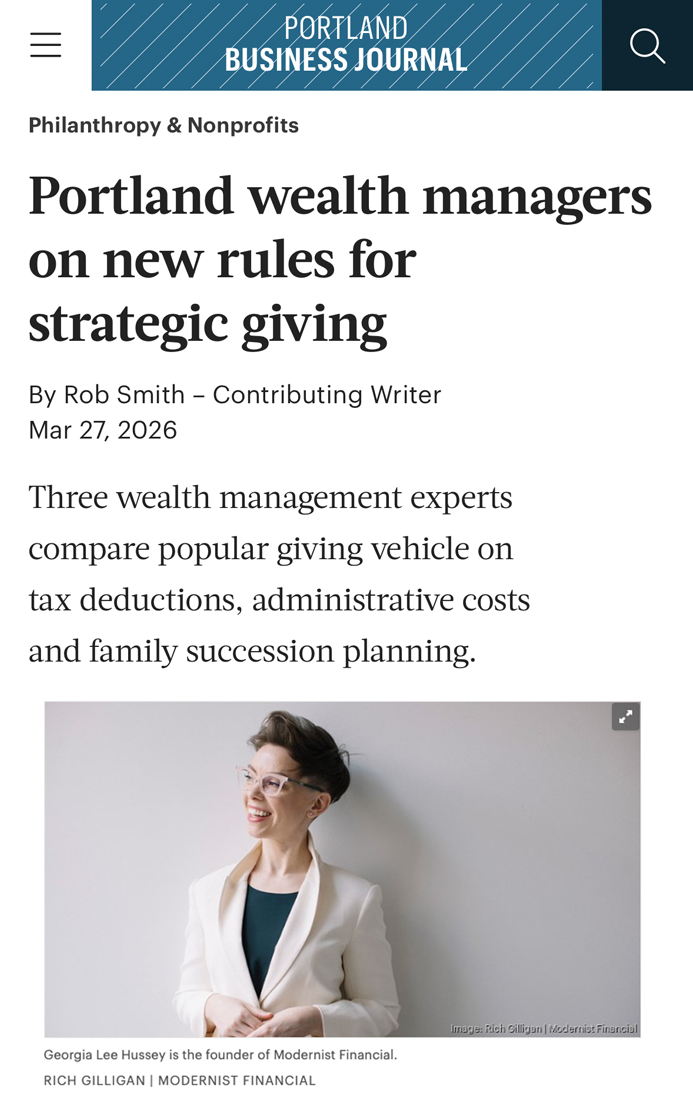
Excerpt: In Georgia Lee Hussey’s mind, financial planning is both an art and a science.
It’s a vehicle to help people clarify and structure their values and vision. It can be complex, but doesn’t have to be overly complicated or expensive. It’s a way to leave a legacy while being true to yourself and your principles.
“Think about percentage of income, percentage of portfolio, percentage of sale at assets. Those can all inform how you organize your estate planning,” says Hussey, who in 2015 founded Portland-based Modernist Financial, a B Corp wealth management firm focused on helping progressive people structure wealth around their values. “Don't control it. Just go give it. The way we give money annually is the way we give money at our death as well.”
What’s the best way to retain control over grantmaking and investments common in private foundations versus lower administrative burdens typically found in DAFs?
Hussey: Why do you want to retain control, and what is the intention of control? And why are we seeking it? You can absolutely control where you give from a donor advised fund. I do think there are some systemic issues with donors wanting control. Trust-based philanthropy (an approach that relies on collaboration between funders and nonprofits) is basically the answer to the idea of donors wanting control over their donations. And I am deeply inspired by MacKenzie Scott's giving and her amazing website, yield giving.com. It's incredible. I send people to that. She doesn’t want to get in the organization’s way and be an administrative burden to them.
How do the tax deductions compare for contributing cash vs. appreciated securities or complex assets like real estate?
Hussey: In 2025 we gave more stock donations than we've ever given before because the market highs last year were extremely unexpected. Our client base is entirely politically progressive and seeing in real time the benefit they were receiving from market gains. The absolute gutting of the social safety net, as well as all the other civil rights attacks, just made people want to give more money away. So, we were just making giant donations, often to a lot of land trusts, a lot of food security, and then to SPLC (Southern Poverty Law Center) and ACLU.
How can someone structure the DAF or foundation to involve children as successor advisers to pass on philanthropic values?
Hussey: This is where I really recommend hiring a philanthropic consultant to work with the family. We love Phīla Engaged Giving out of Seattle. They’re sort of like the Modernist of philanthropic work. They're very committed to trust-based giving, but they will work with the family to understand the culture and values of that family and then how to work with those ideas across gender and generations.
What are the annual costs to giving to a foundation or DAF, including administrative and mandatory payout requirements? (Foundations have a 5% annual minimum payout to avoid excise tax).
Hussey: (Foundations) have a very high administrative overhead. You're hiring investment expertise. You're hiring grant-making expertise. But we only recommend that our clients have their DAFS at a community foundation is because of the 5% rule. Once you put a bunch of money into a DAF, if it’s at a non-community foundation (think Schwab or Vanguard) it could just sit there because there’s no rule that they must pay them out. That's the warehousing wealth problem. We've got trillions of dollars stuck in DAFs with no requirement to get it out of there. But community foundations like the Oregon Community Foundation do major statewide research projects that nobody else is doing because nobody else is funding it.
How do these DAFs and foundations fit into an overall estate plan, including income tax planning and estate tax reduction?
Hussey: We recommend clients leave some percentage of their assets to charity. We recommend starting with 10% to 20%. If we can do that, we can unwind a lot of the wealth inequality issues that are inherent in a state tax and how estates work in America. And with complex assets, this is when you should give your assets into a community foundation, which has the resources to deal with that, because it's complicated.