
What Is Capital Gains Tax? 2026 Rates Explained
MODERNIST’S ASSET CLASS INVESTING PORTFOLIOS ARE STRATEGICALLY INVESTED WITH A FOCUS ON LONG-TERM PERFORMANCE OBJECTIVES. PORTFOLIO ALLOCATIONS AND INVESTMENTS ARE NOT ADJUSTED IN RESPONSE TO MARKET NEWS OR ECONOMIC EVENTS; HOWEVER, OUR INVESTMENT COMMITTEE EVALUATES AND REPORTS ON MARKET AND ECONOMIC CONDITIONS TO PROVIDE OUR INVESTORS WITH PERSPECTIVE AND TO PUT PORTFOLIO PERFORMANCE IN PROPER CONTEXT.
Now that tax season has wrapped up, many investors may be reviewing what drove their tax bill last year. For many, capital gains taxes could have played a significant role.
If your tax professional didn’t walk you through how capital gains tax works or proactively look for ways to offset it for you, it might be time to explore other options. Capital gains tax is a vital part of tax planning that should be considered throughout the year, not only as you scramble to submit your return on time. Understanding the rules that drive this tax today may help you plan more intentionally for the future.
2026 CAPITAL GAINS TAX: KEY TAKEAWAYS
Capital gains tax is owed when you sell an asset for more than its adjusted cost basis.
Short-term capital gains (assets held one year or less) are taxed at ordinary income tax rates.
Long-term capital gains (assets held more than one year) are taxed at 0%, 15%, or 20%, depending on taxable income and filing status.
2026 capital gains tax brackets vary by filing status and taxable income.
WHAT IS CAPITAL GAINS TAX?
Capital gains tax is the tax owed on the profit from selling an asset for more than your adjusted cost basis (generally what you paid for it, plus certain adjustments). Of course, it’s a welcome thing to profit from selling your capital assets. That’s a good problem to have! However, when you do so, it’s important to plan for the increased tax bill.
Capital gains tax is most often associated with assets such as:
Investments (stocks, bonds, mutual funds, ETFs)
Real estate
Personal property (car, home, furniture)
Business holdings
It’s important to note that mutual funds distribute capital gains at the end of each year, which may create taxable income even if you didn’t personally sell shares.
Capital gains are typically realized when you:
Sell appreciated investments
Receive capital gain distributions from funds
Exit a business or real estate holding
Rebalance or unwind concentrated positions
How much capital gains tax you owe depends primarily on two factors:
How long you held the asset
Your taxable income and filing status in the year of sale
REALIZED VS. UNREALIZED VS. RECOGNIZED GAINS
Realized gain is the profit made when an asset is sold or transferred. Unrealized gain is the increase in the value of a capital asset that you have not yet sold, or the “on paper profit”. Recognized gain is the portion of the realized gain that is taxable and must be reported on your tax return.
Not every realized capital gain or loss is fully recognized in the current tax year. This can occur in certain exchanges, exclusions, deferrals, or tax-advantaged accounts. For example, gains and losses held in tax-advantaged accounts such as IRAs, 401(k)s, HSAs, and 529s are generally not taxable in the year realized. Losses on personal-use property are unfortunately never tax-deductible. However, in certain situations, capital gains tax can be postponed until future tax years.
It is especially essential for business owners, real estate investors, and those using proactive tax planning strategies to understand these distinctions.
SHORT-TERM CAPITAL GAINS TAX
A short-term capital gain occurs when you sell an asset held for one year or less at a profit. These gains are taxed at ordinary income tax rates. Your ordinary income tax rate is the rate that applies to your wages and non-qualified income. These rates are typically higher, so it’s usually not tax-efficient to sell at a profit within a year of purchase.
2026 Short-term Capital Gains Tax Brackets
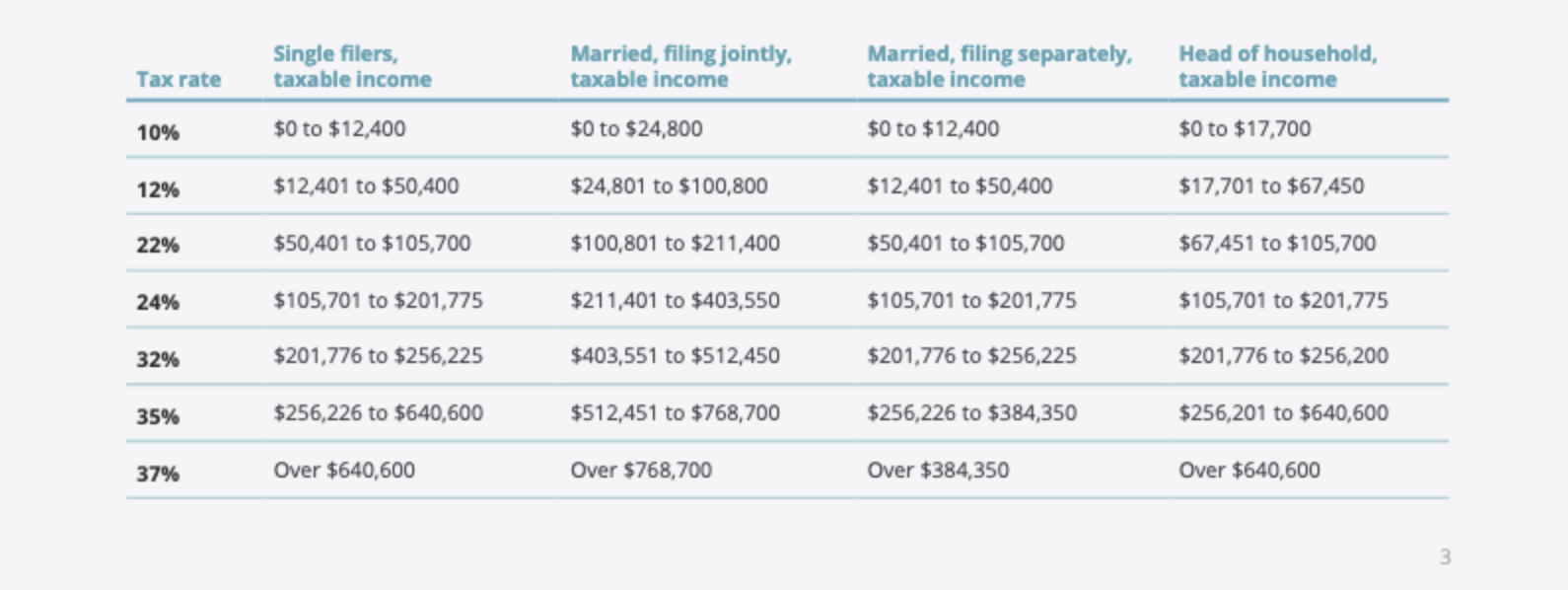
2026 Federal Ordinary Income Tax Rates
Short-term capital gains are taxed according to the 2026 ordinary income tax brackets. These are progressive and graduated rates, meaning income is taxed in layers. Your exact short-term capital gains tax rate depends on your total taxable income and filing status.
Higher-income households may also need to account for the Net Investment Income Tax (NIIT). NIIT is an additional 3.8% surtax that applies once income exceeds certain levels.
FINAL THOUGHTS ON CAPITAL GAINS TAXES
Capital gains tax is an expected side effect of successful investing. The key to minimization is understanding when gains are realized, how they are taxed, and which bracket applies to your situation.
A proactive approach throughout can make a substantial difference in your after-tax results. If capital gains caught you and your tax bill off guard this year, we’d love to help coordinate your future approach. If you anticipate a large sale, liquidity event, or portfolio transition in the future, let us help you coordinate those decisions with a broader investment and wealth management strategy.
FAQs
What is the tax rate on capital gains?
The capital gains tax rate depends on how long the asset was held, your taxable income, and your filing status in the year of sale. Short-term capital gains are taxed at ordinary income tax rates (federally 10% to 37%). Long-term capital gains are taxed at 0%, 15%, or 20%, based on taxable income and filing status, plus a potential 3.8% Net Investment Income Tax for high-income households.
How do I avoid capital gains on my taxes?
Capital gains generally cannot be avoided entirely when an asset is sold at a profit. However, strategies such as holding assets for more than one year, coordinating income timing, and thoughtful planning may reduce the overall tax impact. A proactive investment and tax strategy is often the most effective approach.

Want To Work With Us?
The information provided is educational and general in nature and is not intended to be, nor should it be construed as, specific investment, tax, or legal advice. Individuals should seek advice from their wealth advisor or other advisors before undertaking actions in response to the matters discussed. No client or prospective should assume the above information serves as the receipt of, or substitute for, personalized individual advice. This reflects the opinions of Focus Partners or its representatives, may contain forward-looking statements, and presents information that may change. Nothing contained in this communication may be relied upon as a guarantee, promise, assurance, or representation as to the future. Past performance does not guarantee future results. Market conditions can vary widely over time, and certain market and economic events having a positive impact on performance may not repeat themselves. Investing involves risk, including, but not limited to, loss of principal. Focus Partners’ opinions may change over time due to market conditions and other factors. Numerous representatives of Focus Partners may provide investment philosophies, strategies, or market opinions that vary. The appropriateness of a particular investment or strategy will depend on an investor’s individual circumstances and objectives.
Please be advised that Focus Partners only shares video and content through our website or other official sources. Services and investment advice are only provided pursuant to an advisory agreement with the client. Focus Partners’ Form ADV Part 2A and 2B and Privacy Statement will be provided as required by law and include a description of fees payable for investment advisory services. Services are offered through Focus Partners Advisor Solutions, LLC and Focus Partners Wealth, LLC (collectively referred to in this document as “Focus Partners”), SEC registered investment advisers. Registration with the SEC does not imply a certain level of skill or training and does not imply that the SEC has endorsed or approved the qualifications of the RIAs or their representatives. Prior to January 2025, Focus Partners Advisor Solutions was named Buckingham Strategic Partners, LLC, and Focus Partners Wealth was named The Colony Group, LLC. ©2026 Focus Partners Wealth, LLC and Focus Partners Advisor Solutions, LLC. All rights reserved. RO-26-5291728